
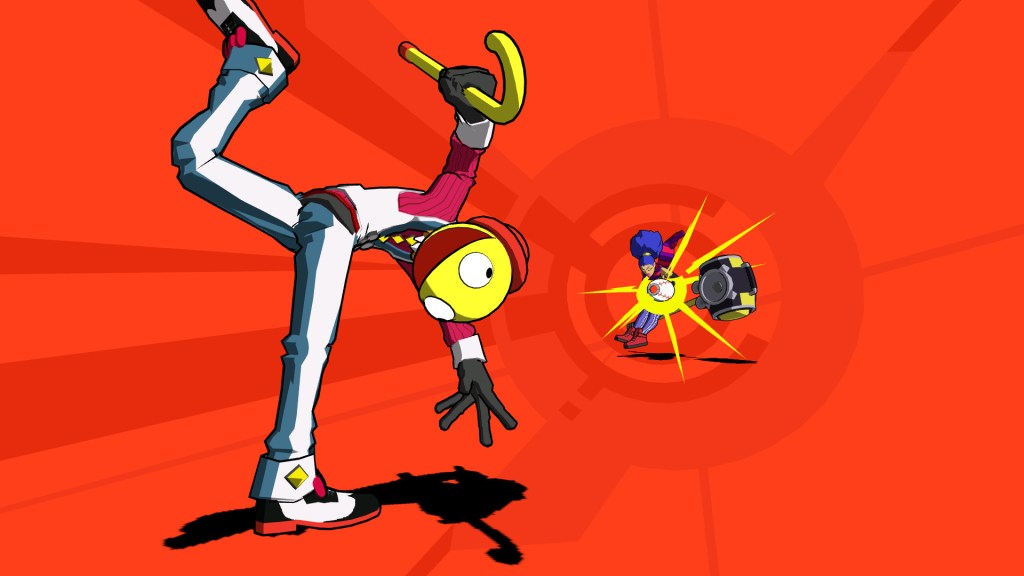
Why are fighting games like Lethal League Blaze and Brawlhalla so much fun to play with friends?
I mean, yeah, obviously a part of that is because of the simple mechanics. That’s why we don’t have to spend hours waiting for our friends to get to our skill level, and why our friends don’t have to spend hours getting rolled until they can actually compete. It allows everyone to actually be able to play the game properly too, so we’re not walking around like drugged chimps trying to kill each other at knife point. We can get to the fun stuff: the cool stuff, faster.
Some of that coolness comes from being able to do the technical things that would usually take you hours to learn in more traditional competitive fighting games, like chaining long combos and setting up special attacks. The interesting thing, though, is that Lethal League Blaze also lets us do the ‘social’ things too: the part that makes it so fun to play with other people . . .
I’m talking about the psychological warfare, the mind games, the mental damage! Being able to read your opponents next move and punish them for it!
Usually, learning how to do that would take a really long time. For traditional fighting games, you’d need to have a deep knowledge of the game to be able to predict someone’s moves. There’s a bunch of different contexts and situations, and also just the gazillion character match-ups to understand. You need to know when each character is vulnerable and what moves leave them wide open. You also need to know what moves your own fighter can use to counter, and that can change depending on the match-up. Sometimes (well, if you take it seriously, often), you have to look at the frame data to know when you have the advantage. I mean, it just goes on and on. Simply put: you need to know what the hell you’re doing.
Lethal League Blaze makes that process a whole lot easier. First of all, it’s not really a ‘fighting’ game in the traditional sense. You’re not really punching and kicking people till they die; you’re hitting them with a ball going 1000 miles per hour. It’s more like rallying in ping-pong, except when one of your friends misses their swing they die.
Every time someone hits the ball, its gains a little bit more speed. Eventually, it gets so fast you can’t even see the thing anymore. But it also takes longer for the ball to start flying off your stick (or whatever tool your character uses) when you hit it. It’s like that pregnant pause in a Shonen anime right after someone gets super punched in the face but right before they get sent flying at Mach 8. In that moment the ball is invulnerable, but it also gives your friends time to walk up to you and hit the ball the instant before it starts flying again. The ‘instant’ is a pretty chunky window too. And when the ball is going fast enough, it becomes really hard to react to it, so you’ll probably die. Luckily for you, though, that’s where it gets interesting.
Instead of just dying, you can press the ‘bunt’ button. When the ball is just flying at you normally, you can use that button to bounce it lightly in the air. It’s nice because the bunt has a short start up, shorter than your regular swings; it leaves the ball up in the air for everyone, though, while if you swing the ball belongs to you (and can’t hurt you anymore, shh . . .).
But, when the ball is already in that ‘pregnant pause’ right after you swing and right before it goes flying, it does something else. It enters a kind of ‘parry’ state where, if your friends take a swing, they just bounce off you and the ball. So, what you can do is, right before the ball starts flying, you can hit the bunt button and completely cuck them out of a hit (are we still allowed to say the word cuck?). The best part is, they bounce directly in the path of the ball, DYING. It’s great.
Luckily for them, though, that’s where it gets interesting.
See, instead of just dying, they can press the ‘grab’ button. In normal situations, you can grab the ball mid-flight and throw it. It’s a nice move because throwing the ball has a different timing than swinging it; that can disturb the natural rhythm that your opponents develop and can make them slip up (and die).
If they press ‘grab’ while the ball is in that parry state, though, they actually just snatch it out of your hands and kill you with it. There’s nothing you can do, you just die!
So, what do you do? Is there some move you can use to counter the grab? Well, yes, but actually no.
To counter a grab, all you have to do is hit . . . nothing! If the ball is in that ‘pregnant pause’ and your friend thinks you’re gonna parry, just don’t do anything. When they try to grab the ball, they get bounced right into the path of the ball (and die), just as they would if you did parry and they tried to hit it.
Cool! But how do you know when your friend is gonna go for a grab, or a swing? Well, you could guess. Or you could make them think you’re gonna go for a parry, which will make them go for a grab, but since you know that, or you think you know that, you’ll just go for a regular hit, making them bounce off (and pass away violently).
“Wait . . . what if they know that I know they’re gonna go for a grab? Then they’ll just hit it!” -You. I guess you’ll just have to parry again. Or not; they might know that you know that they know that you . . . wait, what? – Me
This rock-paper-scissors conundrum is what some people call ‘Yomi’. It’s a situation where Person 1 has Option A, Person 2 has Option B which counters A, Person 1 has Option C which counters B, Person 2 has Option D which counters C, and Person 1 can just use Option A to counter D. It’s a full circle. Both players have an equal amount of options to counter the other. More importantly though, it provides an equal opportunity to both players to predict what the other might do.
That’s where shit gets crazy. There’re so many mind games that people play to predict their opponents moves, especially at a high-level. Like conditioning: doing the same move over and over again, just to switch it up at the last, most crucial moment of a match. Or the opposite: doing the same thing over and over again, and not switching it up, while your rational thinking opponent would assume you would. Then there’s just straight taunting, which is especially easy if you’re with friends. The list is endless.
Note: If anyone actually finds this article somehow and would like to know more, I highly suggest David Sirlin’s article, Yomi: Spies of the Mind (and just everything he’s worked on in general, he’s how I learned about yomi to begin with), and Core-A Gaming’s video, Analysis: Taunting and Mind Games.
In traditional fighting games, like Street Fighter or Guilty Gear (the goat), the amount of yomi situations are endless. It takes a lot of time to identify all those moments, understand what to do, and develop the skill and presence of mind to actually pull off a prediction in the heat of battle. It probably takes even more time to skew those situations in your favor by manipulating your opponent. And who knows how long it takes to master the precise timing of the button presses you need to do.
But, Lethal League Blaze, when you really think about it, only has that ONE true yomi situation!
It’s such a delectable and easy to understand situation too: you know every time the ball is in that ‘pregnant pause’, it’s go-time. And you know that parry beats swing, grab beats parry, and doing nothing beats grab (man, it feels like I’m explaining the concept of rock-paper-scissors to a 3-year-old. Or, that weird ‘reflect-shoot-shield’ game we made in elementary school, which was just an inferior version of rock-paper-scissors. In hindsight, at 21 years of age, that game was horribly balanced. Why would you ever use shield, when you can just reflect? And why did- . . . never mind).
Also, you don’t have to look at frame data and practice in training mode for an hour just to know when to hit someone after your block-stun. You know when you can grab, because the ball turns blue for the entire window! And you know the exact window where you can hit the ball out of someone’s hands (right after the ‘pregnant pause’) because of the meter at the bottom of the screen!
It’s fantastic! It lets us get to the fun part with our friends: the psychological warfare and the hard reads, without any of the work!
It’s also great because it lets the scrubs actually appreciate, and participate in, one of the key pillars of fighting games. It might actually encourage a lot of people to go on and try one of the more complicated fighting games you see at EVO. When you know what’s possible to achieve, learning becomes fun. A light at the end of the tunnel (the tunnel which services the Pain Train) appears.
You could argue that what makes the mind games so enjoyable is the work and skill needed to do it. That it feels rewarding when all your gamer blood, sweat, and tears pay off. But, another part of that fun comes from the risk.
Yomi is at its most intense when an entire match (or set, or tournament) is on the line. When that one decision can cost you everything. And while you aren’t fighting over prize money with your friends in Lethal League Blaze, the ball does take your entire health bar at high speeds. Me and my friends actually don’t play with health at all. It makes it even more spooky when a ball going one mile an hour can wipe out your entire existence.
If yomi is like gambling, it’s the most fun when the stakes are as high as possible. I think the high risk/reward makes up pretty well for the lack of growth in the game (not saying there is no growth, there are people that literally play this game professionally).
Bottom line: (well, I want to say that Lethal League Blaze is like porn, but…)
It’s really interesting how Lethal League Blaze distills yomi into its most basic form, making it super easy for new players to get into. Yomi is one of the most social aspects of traditional fighting games (aside from stuff outside the game like the community that forms around them). So it’s fitting that a simple fighting game meant to be played with friends hones in on that element in particular.

 Slickaria!