

Have you ever been bored to tears moving all of your units, over multiple grueling turns, across the screen in your favorite Grid-Based, Turn-Based Tactical RPG before you actually get to the fun part: the killing?
Me too. Maybe the internet killed our brains at a young age. If you’re my age (21 at the time this was written), we’re the first generation that grew up not being able to comprehend a world without the internet. We’ve had an unprecedented amount of information and entertainment at our fingertips. Do you have twenty tabs open right now? Do you need to be constantly entertained, or at least doing something? Do you have eight random Wikipedia pages open? Maybe that’s a bad thing. Or maybe it’s just a sign of a new kind of society emerging. A new standard (god that sounds so unbelievably pretentious).
Similarly, some of us need that stimulation to carry over to video games. Not all of us, but there are a lot of people out there that need their brain firing on all cylinders to be entertained.
Because of that, I’ve been starting to feel like my favorite Tactical RPGs are missing something. Like there’s a lot of wasted space. And most of that comes from the whole concept of moving your units on the map.
Think about what really happens when you’re moving units in like, Fire Emblem or Advanced Wars (or Wargroove: the new Advanced Wars!). All you’re really doing is getting them close enough to kill another unit. Previously, that concept was perfectly fine to me. Occasionally, I’d get bored of moving units across an empty map screen over multiple turns, but I just accepted that as the nature of the genre. Like, the same way you accept farming in a MOBA.
Like farming, movement in Tactics RPGs is a skill you have to learn. But what it really boils down to is: what is the attack range of my unit vs the attack range of the enemy unit, and how can I manipulate relationship so I can do as much damage as possible before my unit takes any damage. A lot of times, that involves literally just staying outside the exact range of the enemy unit’s movement range, waiting for that enemy to move, then attacking it. Over and over again.
Honestly, it’s just so boring. Move, wait, move, wait, move (while skirting right past the enemy unit’s attack range), kill, move, wait, move, wait, over and over and over.
Moving in Tactics RPGs is just a chore we have to accept before we get to the fun part: the killing. Yet, moving is an important strategy to consider whenever we play these games though. It’s a part of the game. Without moving, there are no tactics.
Even in real life it’s like that. Since the dawn of time, speed and positioning has been one of the most important parts of warfare. Armies have been inventing new ways to kill each other for thousands of years, and probably close to 70% of those ideas involve just walking around.
So why does movement in Tactics RPGs feel like you’re gaming the system rather than coming up with interesting and engaging tactics? I don’t know. I’ve stopped asking questions and just accepted it for what it is a long time ago. It’s really just Stockholm syndrome. Yes. It’s me that’s the problem. The internet killed my brain, yes. Games aren’t obligated to entertain me during every second. You’re only bored of moving units because your brain’s been riddled with too much dopamine, since you were a kid. You forgot what it was like to work for your fun. Maybe I should get off of social media for a couple weeks, that might help… maybe read a book or something.
Invisible Inc., in a way, awoke me from that slumber.
The game is also a Grid-Based, Turn-Based Tactics RPG, but it keeps my zoomer brain engaged, in part, by taking a small step away from the ‘combat’ aspect of the genre and a gigantic step towards stealth.
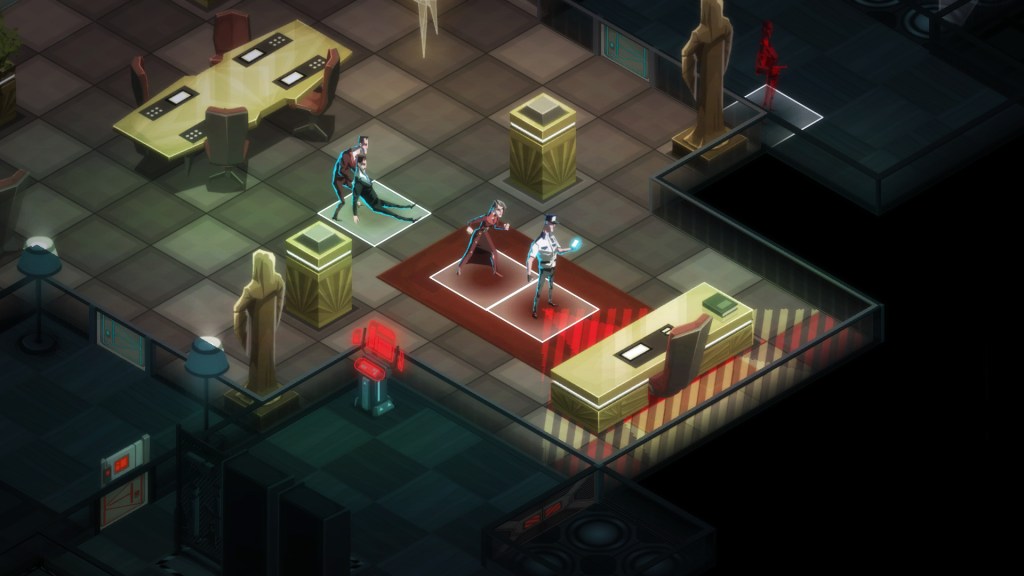
Let me explain the context. You’re controlling a group of techno thieves in a futuristic world where corporations rule. Their hideout comes under attack and they have to escape with minimal equipment, their A.I. helper Incognita, and their GMILF boss. Wireless Incognita is keeping their digital scent hidden from the corporations that are hunting you, but you have 72 hours to get her hooked up to a new power grid before she shuts down, leaving you exposed. The only power source big enough to house Incognita is heavily guarded, so it’s a race against the clock to gather resources, free your friends, get stronger, and gain intel about the enemy for the final showdown before it’s too late.
So, you undergo missions to infiltrate corporate facilities. But your goal isn’t to wipe out everyone on the level or defend some castle. It’s to quickly and quietly steal as many resources and tools as you possibly can. And that leads to some really engaging and interesting situations.
When the game is about stealth, you can do other things besides walk up to people, over the course of multiple turns, to kill them. Like cracking safes, slipping past guards right inside a lapse of their field of vision, hacking terminals and CCTV cameras, subduing a fat cat CEO and downloading the high market value files from his brain bank, the list goes on.
A big part of that is how Invisible Inc. realigns our goals. We don’t want to simply clear levels. We want to make as much money as possible, so we can buy the best equipment and upgrades, so we can deal with the later facilities that house the best guards and tech money can buy, the best of which are in the facility we need to power Incognita. That goal isn’t more easily achieved by killing everything in sight, so we sneak around stealthily instead.
Again, you’re not thinking about how many action-points a unit needs to walk up to a guy, and if your unit can do enough damage to kill it. You’re thinking about how many action-points a unit needs to get to a door, peak through to see what’s in the other room, steal the valuable currency, or useful tool, from nearby safe (and not before hacking it open with Incognita), then hiding behind that same safe just out of view from a guard. Then, considering whether or not you should ambush the guard when he passes by you during the enemy turn, will they see you or not. And setting a unit to ‘ambush’ is a decision you can only make during your turn. Every time you move a unit is a battle carefully considered.
That kind of multifaceted-ness branches out to other areas beyond movement too. If you press the space bar, you enter this ‘Incognita interface’ which allows you to hack certain facility equipment like CCTV cameras, power banks, safe locks, databases, I mean, the you get the idea. And each hackable equipment offers a unique strategic tool for your disposal. For example, hacking CCTV prevents guards from being alerted (and the security level from rising), but it also let’s you see what the camera sees, which is really useful! There’s also the economy of your current ‘power level’ (I won’t make the joke) to consider, which what you need to hack equipment and gained by stealing it from certain terminals. If you run out of power, the next time a camera reboots, you won’t be able to stop it from spotting you. It’s another level of management to think about!
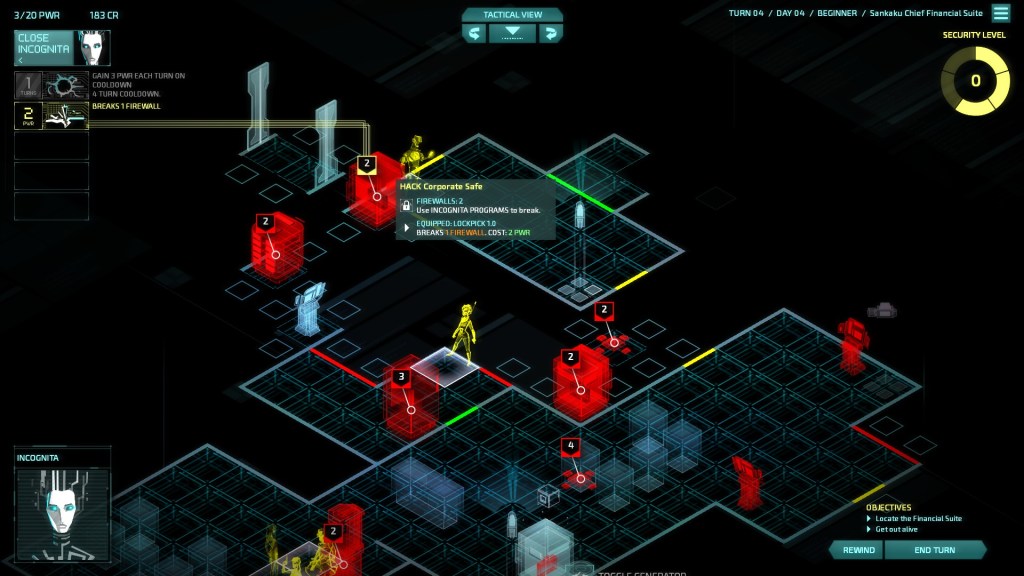
Speaking of economy, credits, the main currency of the game, are probably the most important thing you need to be thinking about. You can get it from corporate safes, out of guards’ pockets, or by selling spare equipment and items. It lets you level up your units, and also lets you buy new equipment. But seeing as how your team is on the run, you can only buy equipment at nano-fabricators, which you can only find in corporate facilities!
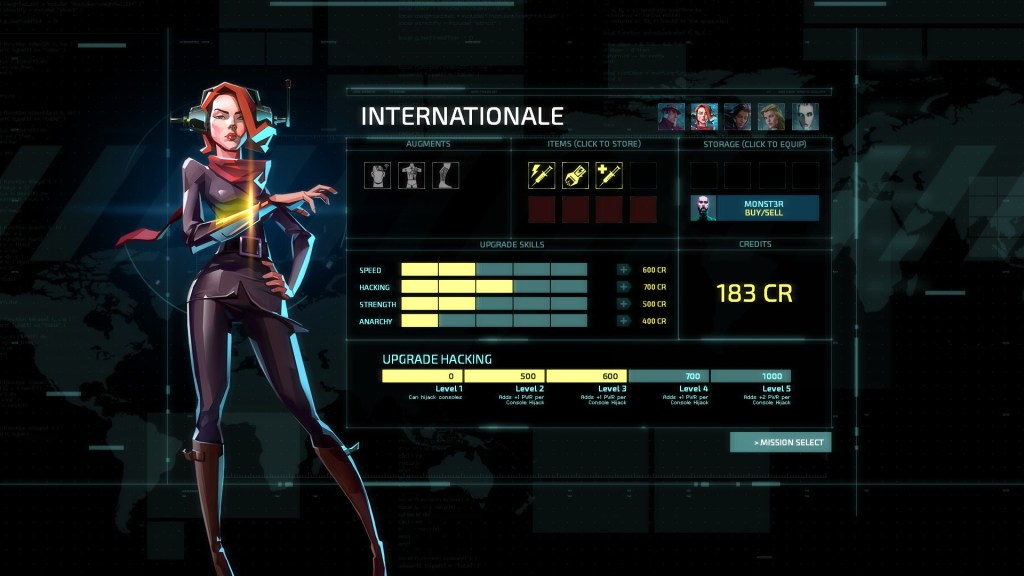
So, one of your first thoughts when you enter a mission is, “Where can I find a nanofabricator, what kind of items and equipment will it have (because it’s randomized), and do I have enough credits for what I want? If I don’t, are there enough safes or should I also pickpocket the guards? Do I have a character that can even pickpocket right now?”.
And then there’s all the different items you can get with those credits, which change the way you can approach each situation. Like stealth cloaks, which is an incredibly useful item (and it’s also something you can only appreciate after you’ve played for a couple hours, but that’s a whole other thing in itself). I mean, it just goes on and on!
You’re thinking about all these different layers of strategy that feed into each other like an ouroboros snake. And the ‘movement’ in Invisible Inc. is all related to it that. They’re all things that you need to consider every time you move a unit.
It feels like this level of strategy and lateral thinking is how it was always meant to be. I mean, even chess is like that. In chess, you’re not skirting your pieces around the outside of some arbitrary range of your opponents’ pieces. Your considering a complex mixture of the potential that a bunch of different pieces have, both on your side and theirs, and how each move you make is affected by that potential. There are no empty, brainless moves that are necessary before we get to the fun part. In chess, every move is the fun part.
Just like in chess, every move in Invisible Inc. is the fun part: the thinking part. And that’s really cool.

 Slickaria!