
One thing that I appreciate about Invisible Inc. is that it serves as a really good entry point into the Rogue-Like genre. I say this because I suck at Rogue-Likes.
No, I’m not saying that Invisible Inc. is just an easy game, but it legitimately possesses some qualities that let new people appreciate what only Rogue-Likes have the potential to offer, without some of the things that absolutely crush our spirits into pancakes. While I agree that the feeling of loss is an important part of the experience, I don’t think it’s necessary for someone who’s just starting out. Would you let your three-year old ride an adult-sized mountain bike with no training wheels?
The concept of ‘entry points’ into a genre is interesting, but it’s also a really nebulous region. Two completely different games can both serve equally well as entry points. So, by talking about Invisible Inc.’s qualities, I’m not saying that those are things that Rogue-Likes must have. I’m the opposite of an authority on Rogue-Likes, I just said I suck at them. But as someone who sucks at Rogue-Likes, I am the most equipped to be able to talk about what pea-brains like me want.
Number One: Well, we’ll get to what one is in a minute.
There was a time where society called what we now know as Rogue-Likes, Rogue-Lites, and what we now know as Rogue-Lites jack shit. Now, actual Rogue-likes are called traditional rogue-likes, Rogue-Lites are rogue-likes, and Rogue…okay I lost my train of thought.
All you need to know is people generally call any game where you die and have to restart a Rogue-Like. Whether or not you agree with that sentiment is irrelevant sadly, seeing as how nobody knows, or cares, about what traditional Rogue-Likes actually are anymore. Rogue-Lites are generally seen as games where you die and restart, but you also gain some kind of permanent reward, so crybabies like me can actually get somewhere.
That’s essentially what Invisible Inc. is (despite the fact that in some ways, the game is more of a traditional Rogue-Like than games that boast of their Rogue-Likeness like Dead Cells or Enter the Gungeon).
Which is what quality Number One is: being able to progress, even if you die! It’s the most basic thing you could ever point out in a list like this, since 90% of these games have some sort of permanent progression now, but it’s still nice!
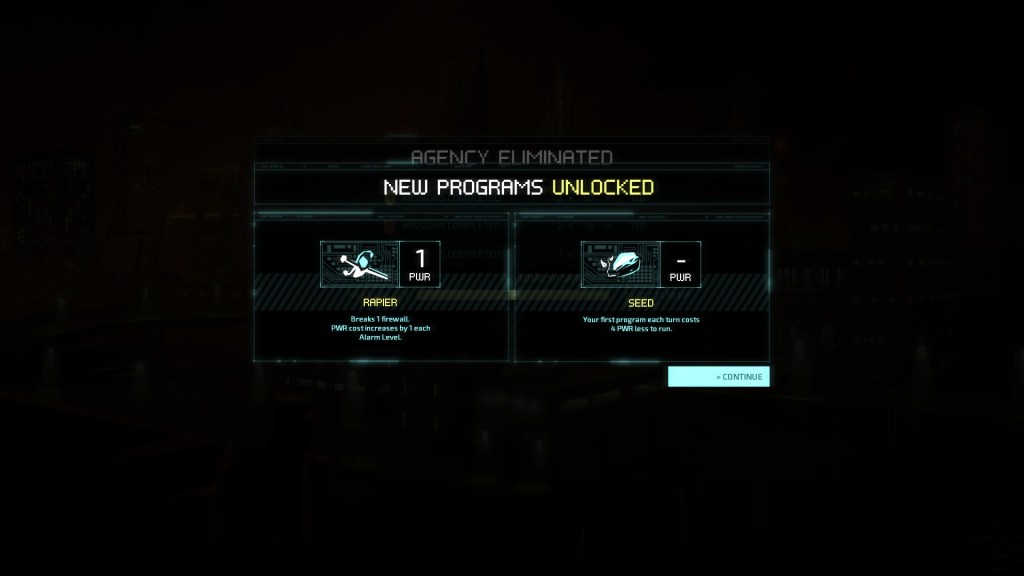
Invisible Inc. allows you to unlock new characters and abilities as you play. What’s really cool is that all those rewards are available when you start a new game.
They’re not just more things that you have a chance to pick up while you play, which is how a lot of these permanent progression systems end up, which isn’t a bad thing! But we’re talking about good entry points into the genre, not what constitutes as the perfect Rogue-Like (in that case, that is probably the best thing you could do, let’s not get into that though). They’re actual, permanent, new ways to play right from the start.
A part of why that’s possible is because all the new stuff that you get isn’t inherently a better option or an upgrade, it’s just a new and interesting way to play. In fact, a lot of them require more game knowledge to use effectively. So, they’re a reward for understanding how to play as well (which is amazing).
The other part of it is because it’s a Turn-Based Tactics RPG, a genre which inherently is better when you have a bunch of different tactics to choose from. Which leads me to my next item on the list.
Number Two: it’s a Turn-Based Tactics RPG.
One thing that a lot the most popular Rogue-Likes have in common is being action heavy.
Take bullet hell games like Enter the Gungeon or Nuclear Throne. Extremely fast paced, prioritizing twitch reactions and split-second decisions. If you mess up only a couple times, without the proper items you’re dead.
Dead Cells, a 2-D platformer, is also a good example. It’s very movement heavy, and focused on offense (from my experience at least). While it’s important to have game knowledge, it’s much better to just . . . be good at platformers.
The issue with that when it comes to new players is that it’s really hard to figure out what you did wrong. When the conditions that got you killed develop in seconds there’s no time to analyze the situation and learn from your mistakes.
In a way, Turn-Based games are a simulation of real time action. So, every moment is able to be picked apart for as long as you want. Every second can literally last an eternity if you want it to!
That’s something that every traditional Rogue-Like had in common in the past that we don’t see that much now, and I think it should be a core part of the experience (at least for new players).
What makes dying over and over again so interesting is the opportunity to be able to correct and learn from your mistakes, and learning is easiest when the game’s as slow as possible.
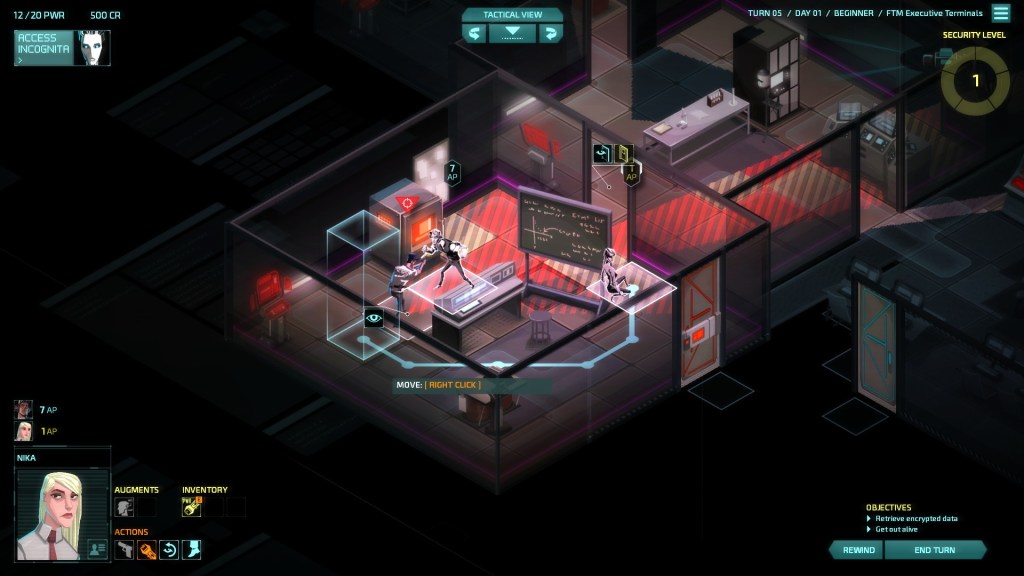
Invisible Inc. is slow. And slow is good.
Slowness also lets new players appreciate other key pillars of Rogue-Likes. Random items are better appreciated in a Turn-Based game because new players can better understand situations where those items would be useful.
When everything is happening at 1000 mph those unique situations fade away in an instant. When everything happens at a snails pace, those unique situations present themselves loudly.
And on top of that, which is a bit unrelated, the game really doesn’t bend over backwards to put you in these ridiculous “I am going to die and there’s nothing I can do” situations that much. When you are in those situations, it’s very clearly your fault, because you have to be greedy enough to stay in a level until the security level is at the point where loads of dudes spawn (which is a whole other really interesting conversation: DO I STAY OR DO I GO?).
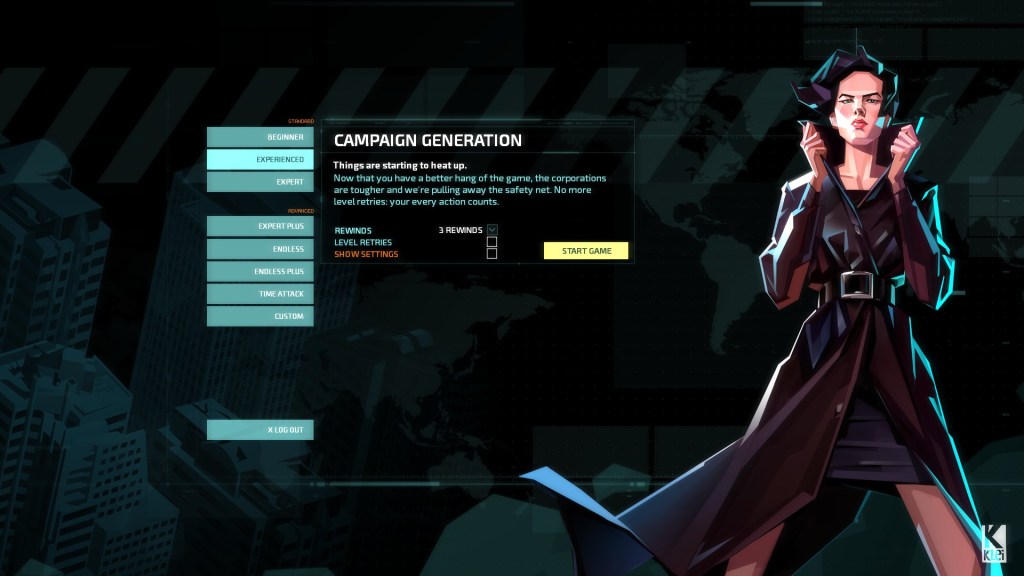
Number Three: Difficulty Levels!
Never before have I played a game that made me drink the bitter draught of ‘Beginner difficulty’ so easily in my life.
I think a part of that is because it’s a Rogue-Like and its so short. There’s really not that much harm in testing the waters out on an easy difficulty since you won’t be stuck with it for fifty hours. And since Rogue-Likes are pretty hard (Invisible Inc. is just as hard as the rest), you can learn how to play on those lower difficulties first, then move on the harder ones once you master the game at that level.
That lets you set goals for yourself. Like, I told myself that after I beat the game on Beginner I would move on to the next difficulty and never touch it again. I don’t think I’ve ever had half a mind to play a Rogue-Like again after I beat it once. And I never have.
Of course, that’s because I’ve never beaten a Rogue-Like in the first place, because I suck at them, which I established loud and clear earlier, and have no shame in declaring (because that’s the point of this entire thing!).
That actually elongates the game. Your ultimate goal is to beat it multiple times now, not just once. And each time you bump up the difficulty you’re slowly progressing towards the real deal, the final challenge. That’s really cool.
Invisible Inc. actually makes it clear that Expert level, what comes after Beginner and Experienced, is the way the game was meant to be played. And let me tell ya, that ain’t no croquembouche. So, you’re really just on training wheels till then.
Every time you beat the game at a higher difficulty, it’s a huge pat on the bag and motivation to keep playing, keep learning, and keep getting better. To get to that end goal. Which is a lot further away than beating the game once.
As a new player of the genre, that’s a way better learning curve than just getting pummeled into the ground over and over again. (Slay the Spire is also a really good example of that, except it has like twenty difficulties or some crazy shit, so let’s not get into that.)
That’s it. Those three elements (that I can think of now!) are what make Invisible Inc. a great entry point into Rogue-Likes.
Permanent progression, slowness, difficulty levels. These are some of the things that allow new players to appreciate the best of what Rogue-Likes uniquely have to offer, without all of the soul-sucking nonsense that makes other games in the genre so daunting.

 Slickaria!