
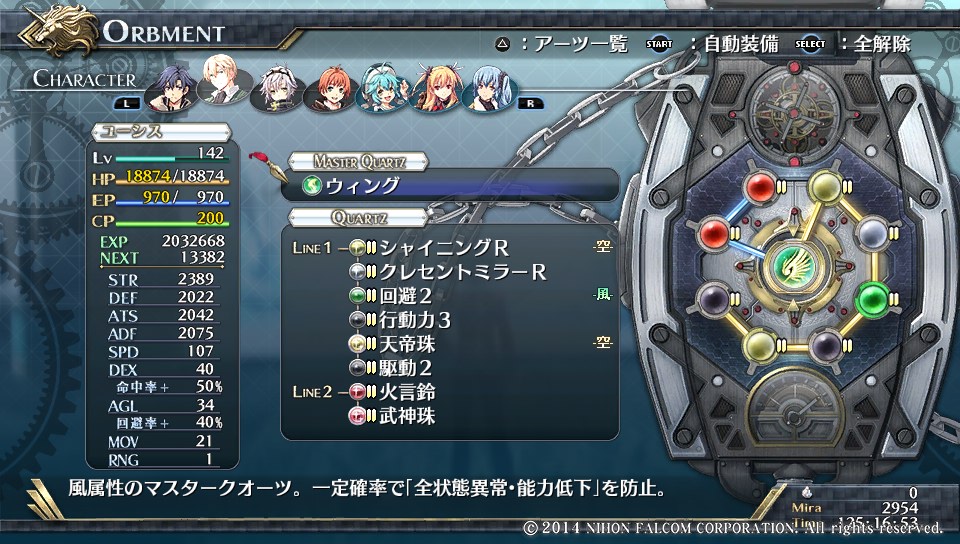
The ‘orbment’ system in The Legend of Heroes: Trails in the Sky is seriously fun to play around with and makes us feel good when we actually decide to use our brains once a while. More importantly though, it allows us to ‘roleplay’ better. Seeing how Trails is a Role-Playing Game, I’d say that’s a pretty good thing.
Note: The above screenshot is from a later game in the series: Trails of Cold Steel. I could have used my own screenshot from Trails in the Sky, I just thought this menu looked way cooler.
Every JRPG needs some kind of wilding-out game system. In a lot of cases, it involves the combat. While Trails has some insanely interesting things going for it there, if there was a national competition to see which JRPG had the zaniest feature, the orbment system, which resides mostly in the menus, would be Trails’ representative.
I’m not even saying that the orbment system is that crazy or confusing. It is a bit at first, but it doesn’t take long to figure out how it works. And that’s where the fun begins.
What are orbments though? In-universe, they’re devices that people wear that can be slotted with magical gems called quartz. And quartz are cool. They can provide different combat stats and perks to whoever’s wearing them.
A party member could be wearing a quartz that gives them extra health, or extra damage, which is fairly basic. But there are also things that can give on-hit benefits (meaning hitting an enemy has some extra effect). For example, there’s the ‘Impede’ quartz that gives characters a chance to stop an enemy from channeling a spell. Or ‘Petrify’ which provides a small chance to petrify an enemy with normal attacks and abilities (but not on spells).
And you can do some wild stuff with those perks if you put your mind to it. Take ‘Petrify’. Normally, it has a 10% chance to petrify an enemy, and for a good reason. Because once a character or enemy is petrified, if they get hit again it’s a K.O.
However, if you equip that quartz on a party member with an AOE ability (abilities that can target multiple enemies, or allies), you can actually increase your chances of petrifying something.
Think about it. If you use an ability that hits three enemies while equipped with Petrify, that’s 10 + 10 + 10%, for a 30% chance of petrifying something. I know that sounds wack, but that’s math, baby. And that can be so incredibly useful in a tough fight to try an K.O. an enemy quickly, before your party gets dropped. I could go on about how cool ‘synergies’ are in this game, but I think you get the idea.
So that sounds cool, I know. We’re on Level 1 right now with orbments in Trails in the Sky. Let me take you to Level 2.
Each quartz is also tied to an element. For example, ‘Health’, which gives the character that has it equipped extra health, is colored blue. That means it’s a Water quartz. When equipped, it gives the party member in question a ‘Water point’. (That sounds dumb, but I honestly don’t know what to call it. This stuff’s confusing as it is with ‘orbments’ and ‘quartz’ so I’ll just use simple names where I can.)
With that one Water point, the character suddenly has access to two new water spells! A heal, and a damaging spell. That’s useful.
You see, elemental points imbue party members with element specific spells. If you equip a quartz that’s fire, you get a fire spell. But it’s a bit more complicated than that, because the spells are tied not only to how many points you have in a certain element, but what combination of points you have in all elements. That’s where shit gets crazy.
Take the ‘Lightning’ spell. You need three Wind points, and a Space point (don’t ask me why space is an element, I don’t have the answers). How you achieve that numerical harmony is up to you, because there are a lot of quartz combinations that can get you three Wind points and one Space point.
And that’s really cool, because it’s a form of player expression and more importantly, ownership. However way we get the points we need for a whatever spell we want, we got there on our own.
Well, at least partly. We can actually see how many points in each element is necessary for every spell right at the beginning of the game. All we need to do is consult the Bracer Notebook. So, since we already know how many points are needed, it’s more of a test of identifying which quartz can get us there in the first place.
Here’s a scenario. You look at the Bracer Notebook and realize ‘Lightning’ needs three Wind points and a Space point. However, you currently only have two orbment slots open at the moment. One is occupied by a wind quartz that gives two points. The other is a space quartz that gives one.
All you need is that one extra point to get ‘Lightning’, which is a spell you really want because it can target however many enemies you can catch in a line, and has a 20% chance of interrupting spell casts.
Aside: Can I just say that getting enemies lined up for a line AOE spell is seriously one of the hardest things to do in Trails? Like, it’s hard enough that such a specific scenario needs to occur to get enemies to line up like some kind of fucking Conga Line, but you have to predict where they’re gonna be because it takes up a turn to cast a spell. I don’t know, it’s just crazy.
But you finally reach the next town and find an Orbal Factory (a place that specializes in quartz manufacturing and orbment modifications. . . man, it sounds like I’m talking about an actual place. Shout out to world-building.), and you check out what they have for sale.
And would you look at that, there’s a quartz worth three wind points! Congratulations. Now you can finally try out that spell you’ve been eyeing for five hours.
Conversely, they might not sell a quartz like that there. But you could unlock another orbment slot if you have the Sepith (a secondary currency picked up from monsters). That would let you add another wind quartz, if you have one, so you can get that extra point.
And let’s not forget about the stat bonuses those quartz give you too. Would you be willing to give up that ‘Impede 3’ which gives you an 80% chance to interrupt an enemy casting a spell so you can equip that wind spell you’ve been eyeing.
I mean, this stuff really turns you into a mad scientist. Weighing the perceived worth of whatever stats a quartz gives you over what spell another might allow you to use. Keeping track of the Sepith needed to not only unlock new orbment slots, but to buy new quartz in the first place! Considering that some characters have one or two orbment slots that only allow them to equip one kind of element, and how that affects all the other slots that they have. I mean it’s just so insane.
But in all that insanity is a system that allows you to really customize your party members in whatever way you want. If you want to make the main character a really strong healer so your party never dies, go for it!
Dump all the Sepith you can get your hands on into just them to unlock all their orbment slots as soon as you can. That way you can start using AOE healing spells and other crazy stuff.
It’s a lot like a skill tree, in terms of an RPG telling you to “choose what you want your character to be good at” but it’s on another level. And I’m not just talking about complexity (which is always welcome).
Its like this. In your typical skill tree (this is kind of a contrived example), you get skill points or EXP by killing monsters or leveling up. Then you can put those points to get all cool abilities and spells you want. You get to decide what your party members get good at in traditional fashion.
The points that we get are a representation of your experience in battle. The more battles we survive, the more we’ve experienced, and the stronger we become. Sometimes our experience allows us to gain new insight into the art of combat, and we develop a new spell or technique.
That’s growth. Yet, it’s not our growth. Well, it is, since we’re roleplaying as our main character. But we’re not ‘learning’ a new ability, we’re just unlocking it.
While that’s also true with orbments in Trails in the Sky, there’s actually a big difference. Not one single spell in the game is unlocked with EXP or skill points. Which also means, for example, the ‘healer build’ you might give to the main character didn’t come from a skill tree.
Whenever we equip a party member with a new spell, we figured out we could do it. It didn’t come from points; it came from our own genius.
And that feels so incredibly good. Realizing that with the quartz available to you, or quartz you might be able to buy, you can put together an orbment that lets you use that AOE healing spell which would let you survive that tough battle you were struggling with, is godlike.
That is learning. That’s your own growth. The potential was already there, it was just up to you to understand you could tap into it. And it’s such a more powerful connection to our player characters. When we grow, they grow.
That growth comes from a bunch of different places too. You need to learn to experiment with the different ways you can reach certain combinations with the quartz you have available to you, true.
But you also need to learn about sepith management, because that currency lets you buy new quartz, and also lets you unlock more slots in your orbment. And let me tell ya, there is definitely not nearly enough of that stuff to get what you want whenever you want.
Then there’s the different synergies that come from mixing the passive stats from quartz and the spells that a character can use.
Note: It’s basically an example of ‘Random Parallel Learning’, where to learn how to do something, you need to get good at a bunch of other little things that make up the whole. Check out this GDC talk by Tom Cadwell, a Riot Games dude.
When we learn, our characters learn. It takes the idea of roleplaying to another level.
So, what’s the big deal with roleplaying anyway? Why would you even care about that? Well, a part of it is having ownership over what you do.
At least for me, I find it way more fun to do things that I had a part in, that I had some control over. When I use a spell that I, in a way, crafted on my own, it feels really good. Something that I can take pride in (that kind of ownership extends to other parts of the game, but that’s a whole other thing on its own).
That’s what the orbment system does for us. It sends us deeper into ‘it’. Into that wholesome JRPG experience that we know and love. And that’s really cool.
Big Aside:
To be fair though, ownership doesn’t completely belong to us. What and how many points you need from what elements is shared with you in the Bracer Notebook. And the quartz that you have access to is limited by what the Orbal Factory’s are carrying and what you pick up from quests.
However, all that tells me is that this is still a crafted experience. The developers at Nihon Falcom didn’t just randomly throw together recipes for spells, the designed it. And they limited what quartz we can use because they didn’t want us getting ahead of ourselves.
It’s just like balancing in any RPG. You don’t have access to every spell at the beginning of the game, you have to earn it.
Likewise, just because you have to mix and combine different elements like you’re Walter White doesn’t mean you deserve to have access to everything immediately. And if we didn’t have the Bracer Notebook, we’d be sitting in the menus day and night trying out every possible permutation of elemental points. That’s not fun!
The designers gave us the wheel, but they still have the passenger side brake pedal installed to protect us from ourselves.
Since the orbment combinations are crafted, the learning curve is fairly balanced and enjoyable. All those “a-ha!” moments we experience is clearly from our own growth, but they’re supplemented by all the design choices made by the people at Nihon Falcom (You could probably get into the specifics of how, but that’s a whole other thing on its own).
The design of it, the resistance to randomness, is the linchpin in this whole thing. It’s our ownership, our roleplaying, but controlled. And that’s also pretty cool.

 Slickaria!
One thought on “The Orbment System In Trails in the Sky Gives Us Character Growth We Can ‘Feel’”