
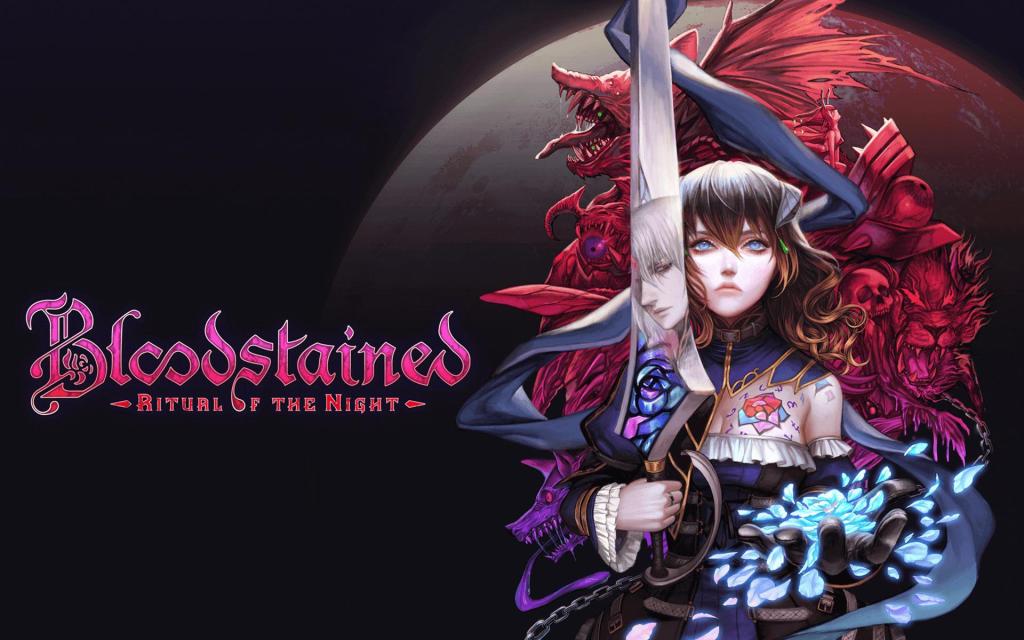
Bloodstained: Ritual of the Night feels like a game that an advanced A.I. concocted, after consulting the YouTube comment sections of ‘Metroidvania’ videos for nine years. The issue is that A.I. can’t tell interesting stories. . .
Bloodstained has all the elements of what people want in the ‘Metroidvania’ genre. It has 2D platforming. It has non-linear progression. It has item and ability pickups. Customization. It has it all.
However, I don’t think that’s what people actually want from Metroidvanias. The items listed above are just elements that service a greater goal: exploration and adventure.
People want to explore! They want to traverse unknown territory, and get lost in a world. And they want to tell their own stories, whether they know it or not (but we’ll get into that in a bit).
Bloodstained doesn’t let you explore. It doesn’t let you go on an adventure. It does have a lot of those ‘Metroidvania’ surface elements, but they’re just. . . there. The game is like a bad, meta-version of itself, or at least, the game it’s re-creating. It’s Castlevania: Symphony of the Night, but it forgot what it was trying to do.
I think a lot of that comes from the fact that there’s no ‘story’. While I mean that in the most literal way possible (the story is quite missing in action), I also mean that in a lot of fairly more important ways.
Let’s talk about the actual story first. I can confirm that it’s there, yes.
But that’s it, aside from just being there, I couldn’t tell you what it’s actually about. To be fair, that’s probably my fault. I checked out of that ride during the first thirty minutes of the game.
I mean, I really just couldn’t take it seriously (I promise I’m getting to the point). On one hand, the writers (if there were any) want me to care about a primary character’s tragic backstory. Fair enough. On the other, there exists an edgy, bearded, samurai character named ‘Zangetsu’ (please), that looks like he popped out of a Shonen anime from the mid-2000’s. Mind you, this story takes place in mid-18th century Europe.
That’s all well and good. We can all laugh at how corny the story is, it’s actually a plus. But where it gets sad is how that fucks up the game itself.
The plot, in a Metroidvania and in an open world game in general, is probably the main driving force behind exploration. In Hollow Knight, we must travel to the City of Tears. In The Legend of Zelda: Breath of the Wild, we must defeat Ganon and free Zelda. In Dark Souls (I’m sorry), we gotta ring them Bells of Awakening.
I suppose it’s a bit of a carrot on a stick. It gives us something to look forward to, and more importantly, look out for. It’s the driving force to do what we do. Why we wade waist-deep in the mud, why we bathe in the blood of our enemies.
If we don’t have a goal, though, we can always just rely on good old curiosity. Seeing what’s around the next corner is always a good excuse to explore. To have that curiosity factor though, the game needs to facilitate that (but we’ll get to that in a bit).
Bloodstained doesn’t have either of those things. For one, the plot, while basking in its own existence, doesn’t do anything in terms of exploration.
I could not tell you why I did the things I did in Bloodstained (jeez, I sound like I’m pleading insanity). Our ‘NPC helper’ characters, namely. . . I can’t even remember their names-anyway! Those characters never give us interesting goals beyond, “Go kill the final boss”.
When you tell me to go kill the final boss, I’m going to assume (whether consciously or not) that everything else is just a barrier preventing me from accomplishing my goal. That every area prior to that final showdown is just, I don’t know, ‘Some Area That Contains an Item I Need’.
That’s what the areas or zones or whatever you want to call them are. They’re just. . . barriers.
As we all know, ‘story’, especially in video games, isn’t just related to the plot and characters. Exploration games have the immense opportunity to tell stories through their environments, through their worlds (I’m talking about world-building here).
Environments can be more than just ‘levels’, they can be places! And when you’re exploring a ‘place’, things become a whole lot more interesting, trust me.
We can internalize the logic of a world when it’s a place. To make assumptions and actually be curious about what lies around the corner. When we see a gaping hole in the floor of a basement, we start to wonder where it leads.
Beyond just spatial logic, there’s a place’s history. History can make us reflect on a place’s significance, and more importantly, give us clues about the future.
Take that basement (which I completely made up). It turns out that building used to be a den of vampires, until they abruptly disappeared years ago. . . all of a sudden, that gaping hole in the basement’s looking real dark.
We could get into how much atmosphere can be used for effect too. Music, color palette, and whatever else you can think of, play a huge role in that.
Bloodstained has none of it. When you get down to it, the zones are just video game levels.
Connected to the underground waterway is an inferno cave? At the tip top of the castle entrance is an oriental sorcery lab (what the fuck?), that’s actually just a blue forest? There’s whole desert, sandstorms, quicksands and all, towards the bottom of the castle. Like, I’m genuinely confused still, as a type this.
The areas have no internal logic or basis in reality, and there’s no story being told through those areas. They were made because they sounded cool. There’s a desert, in a castle, because why not?
Where it gets really bad is while simultaneously not giving me anything to care about in the world, it asks me to do things to beat the game that are only possible by caring about its reality!
Like, understanding you need a train pass to ride the train. Which is perfectly acceptable when you think about it in a vacuum. Except, in the previous zone, to cross a gap in a bridge too wide to jump, I had to ride in a zombie’s flying chariot, and he’d only let me fly across if I moved a four-foot-tall pillar out of the way with my magic hand.
Additionally, getting the train pass requires you to do a convoluted process involving treks across the entire world map to pick up items you have no idea you need (mind you, the game doesn’t even tell you that you need a train pass, for all you know, you might need another magic hand).
When the world has no consistency, there isn’t any room for us to engage with and be curious about it. To make assumptions and more importantly, make interesting decisions.
If you find yourself in the sewers of the City of Tears in Hollow Knight, for example, you might make the correct assumption that there could be an outlet nearby. That’s a ‘plot’ goal you just set for yourself, even though the game didn’t tell you anything.
Those sewers are also really dark. The pipes you traverse through are long and cramped. And they’re filled with giant infected larvae men (or something) that leap towards you as soon as they see you.
It creates a really oppressive atmosphere. I can’t speak for everyone, but that zone definitely had me cringing (in fear) almost the entire time. Listening with bated breath for the “plip-plop” that sounds the arrival of those wet freaks carries a lot of tension.
That makes it even better when you make it out, whether through that outlet I mentioned, or other means (I won’t spoil it). And that’s your own story. You persevered, you survived, and found your way out of that shit hole.
Or even better (and much more relevant). Finding the tram pass in a secluded area of the game and realizing you can now ride the (previously thought to be abandoned) tram at the bottom of the map!
Bloodstained doesn’t have moments like that. Every area is just a series of haphazardly conjoined rooms that have no significance in terms of their layout, or their story. They’re just, video game levels.
And having ‘video game levels’ isn’t a bad thing. Mega Man 11 doesn’t need to explain to my why there’s a flaming wall chasing me in Torch Man’s stage. So why are the levels in Bloodstained so monotonous? It’s because unlike Mega Man 11, its level design isn’t even telling a story.
There’s a difference (I promise)! In this GDC talk by Celeste developer Matt Thorson, he explains how every screen in the game tells a story. And he’s not talking about lore, trust me.
He’s talking about level design. How the level, ultimately, tells a story. In Celeste, that means jumping over a pit of spikes, landing on the side of a crumbling wall, jumping off to safety just before it sends you to your death. The ‘level design’ is crafting a playground that lets people experience that ‘story’.
Mega Man 11 (a better example since it has, you know, things you can kill) has a lot of those moments too.
Like Bounce Man’s level. That zone sees you shooting at enemies while you’re on rotating hands that slap you away after a timed delay, only to have different colored hands show up again later that slap you in the reverse direction, steering you towards progress!
Shooting at enemies, and having to use a dangerous tool that has the potential to push you off the stage at the same time, a tool that was previously only an obstacle earlier in the level, is really fun. It’s a ‘story’ of the level, if you’re reaching.
There are no stories to experience in Bloodstained. The levels don’t do anything beyond acting as a ‘Place for Monsters to Hang Out’.
Because of that, there’s no adventure, and there’s no exploration.
If you start to think about it too hard, you might realize there’s only two types of rooms in the game: vertical rooms with staircase platforming, that lead to other horizontal rooms, and horizontal rooms that just have enemies in them.
Then you start to realize, like the world and levels the Bloodstained team created, it kind of feels like they made things. . . just because they could. Or at least, because Castlevania: Symphony of the Night did it.
Like, why is there a skeleton dinosaur that shoots lasers in the ‘inferno cave’ underneath the castle? Or the samurai edge lord? Or the ‘oriental sorcery lab’ (what the fuck?) that’s actually a gigantic forest, at the tip top of the castle?
Or in more ‘game’ aspects of Bloodstained. Why do individual weapons have useless special attacks? Because why not! Why can you only learn them by reading notes from random bookshelves scattered around the castle? Because it sounds like it makes sense.
Why are there RPG systems like stats? Why are there so many equipable items and accessories? Why are there so many weapons? It’s because they’re features that people want, not because they’re integral to the experience. They’re there because they can be.
Ultimately, it’s because Bloodstained is meant to be a spiritual successor to Castlevania: Symphony of the Night. It’s directed by Koji Igarashi, and the team’s Kickstarter backers just wanted more of Symphony.
They want all of its features, regardless of why they were put in the game in the first place. They want a ‘Metroidvania’. Bloodstained ends up feeling like it was designed by an A.I. that took note of every single feature that every single backer paid for.
In the end, I guess that’s fine. Tons of people love the game, it met critical success at the time, from what I’ve seen. It’s not like the game is bad, I mean, it’s fine, really.
So, I guess I’m just a hater.

 Slickaria!