
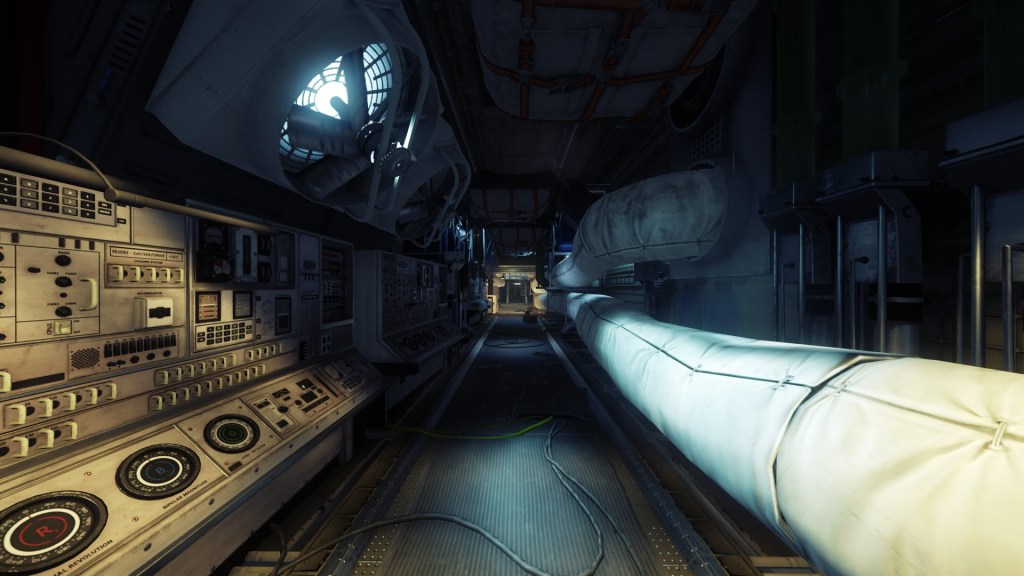
Intricate environment art and design allow us to connect deeper to the story of TALOS 1. It allows us to connect to it’s inhabitants stories. And it allows us to create stories of our own, by getting us to think about the station as place first, and a level, second.
TALOS 1 is a place first, and a level second. It tells a story.
The space station is real. The foyer of the Hardware Labs is an office dressed in an art deco finish. Walls are paneled with mahogany wood and floors are tiled white. Windows to the outside present a view of outer space, with other massive segments of TALOS 1 in the periphery.
Individual workstations are carpeted with a soft grey. They’re separated by large window panes framed with, probably, the same mahogany wood.
The workstations themselves contain desks topped with computer terminals and TranScribes, stacks of research notes and books.
Desk drawers and cabinets are filled with nuts and bolts, spare parts, but also, snacks and drinks.
People who operated in the Hardware Labs were engineers, before they died. This was a space where they could work hard, but comfortably.
Past the foyer is a hallway with a security booth. Through iron barred windows, there’s a computer terminal that has the Hardware Labs blueprint layout as well as a log of where everyone on the station is at all times.
Firearms sit inside a locker at the back of the booth; when people still worked at the station, the Hardware Labs was a restricted area. The weapons locker exists to enforce that restriction.
Farther down, the hallway opens up to the Atrium: a lofty connecting hub that’s surrounded on all sides with various subsections of the labs. There’s a gravity shaft, an elevator that floats entrants up or down rather than carrying them, that leads to the second floor.
The Atrium itself appears a little different than the foyer. Gone are the mahogany wood paneled walls and soft carpets. In their place are uneven tiled floors and insulated air ducts snaking along the ceiling. The walls are painted white, dashed with red.
Maintenance shafts are hidden behind shelves filled with toolboxes and spare parts. A heavy-duty electrical transformer stands by the entrance of the machine shop. There are workshop rooms that were once used for repairs.
The people who once worked here weren’t the office jockeys in the foyer, but were engineers busy with upkeep around the Hardware Labs.
Considering the central location of the Atrium, it must have easy for those engineers to get from place to place. Conversely, it must have also been easy for everyone else to bring their problems and their broken machinery to those engineers.
Past the electrical transformer, the machine shop itself is just as large and lofty as the Atrium. Even more so.
On the ceiling far up above are the familiar white tubular air ducts. Accompanying them are stout steel railings that crisscross over each other, used to ferry the orange platforms that carry materials back and forth around the upper levels of the shop.
Towering blue-grey insulated walls lined with metal framings are topped with humming industrial sized fans; a far cry from the warm mahogany wooded walls of the foyer.
Underneath the steel festoonery are the same ash white tile floors with uneven placement. Strewn among them are crates and power cables snaking to heavy machinery. Portable light fixtures illuminate the shadowy interiors of supply closets and control rooms.
Supply closets are filled with haphazard stacks of spare parts and tools. Through half drawn window blinds, darkened control rooms are lined with bright blank computer terminals once used to activate transport platforms, among other things.
A great moon door sits squarely in the middle of that soot-streaked ashy white floor that, likely, once presented a great view of outer space, with the Earth and Moon closely spinning in and out of view.
TALOS 1 is a place first. It tells a story. Its inhabitants tell one as well.
Players will occasionally discover TranScribes hidden away in desk drawers, security safes, and more likely, beside the corpses of their users.
These portable communication devices contain recordings of conversations between crew members. These conversations always provide more insight into the story of TALOS 1.
A senior researcher of the Hardware Labs sends a request for repairs on his Looking Glass monitor. Later, an engineer informs him of her progress, except the researcher can’t seem to remember sending in the request in the first place. . .
On another TranScribe, the head of the lab division urges another researcher to hurry to his office. They discuss an explosion they heard. Clearly a moment shortly before disaster.
They might contain evidence a burgeoning romance between two lovers. Or a group of friends in the middle of a board game session.
TranScribes aren’t the only way to learn about the station’s inhabitants.
Computer terminals will often have the name of its user on the top of the screen. They’ll usually contain sensitive emails sent to them from other crew members, professional or not, as well as any files they might possess on their workstation.
Personal effects stashed away in living quarters tell more of a person than whatever one might find on their corpse. And the area surrounding that corpse can tell much more of other things than personal effects ever could.
Corpses of former crew members can be found lying in sealed off maintenance shafts. Or next to circuit breakers with spare parts in their possession. Or slumped over in their chair by a control terminal.
Or a bloated, discolored version of their former self, pointing, with a deadly firearm in hand.
TALOS 1 tells a story. Its inhabitants tell a story. TALOS 1 is a place first, and a level second.
Players will likely find themselves in need of what lies inside the dimly lit interiors of security booths.
Computer terminals, whose screens are often the best source of light in a booth, always contain a downloadable map of their respective department. A useful tool for finding one’s way around the layered vastness of the space station.
That vastness also makes it difficult to find one of the many crew members scattered about the station. Thankfully, security computers contain the location of every TranStar Employee, dead or alive, provided their mandatory tracking bracelet is still attached.
Firearms and ammunition stored in booth lockers are a necessary tool as well, if one is to stand a chance against what lurks in the dark.
However.
Players who expect these boons to be given for free, are mistaken.
Aside from iron-barred windows, preventing the usual strategy of breaking-and-entering that many adopt early in the game, the doors are electronically locked. One would need the four-digit access code or, depending on the lock, a keycard to open them.
Some might get lucky, and find this mystery access code scribbled on a sticky note in a lounge, for a forgetful friend. Or hear it mentioned in a TranScribe communication between two colleagues.
Others might not, and will sift through a dead security officer’s pockets for a keycard. A process made easier with the use of their tracking bracelet. . . and if one knows who to look for.
Many will simply bypass the lock. Provided they’ve installed the right Neuromods to their brains, in an instant, they could learn the ability to hack into complex computer systems.
Few will notice, under the solid iron bars of the security window, a small hole that was once used to pass documents and identification to officers of the checkpoint. Depending on the particular booth layout, beyond it might be the bright light of the computer terminal, sitting starkly against the dark.
It’s a hole undeniably too small for a human to pass through. However, given they have a Huntress Boltcaster, a toy crossbow developed by Hardware Labs engineers for fun, they might be able to get a foam dart through. With one or two well-placed shots, they could navigate the touchscreen of the terminal. . .
. . .and activate the manual lock override, opening the security door.
No matter what method players use, they engage with TALOS 1 as a level, by thinking of TALOS 1 as a place.
TALOS 1 is a place first, and a level second.
It tells a story. Its inhabitants tell a story. We tell a story too.

 Slickaria!