
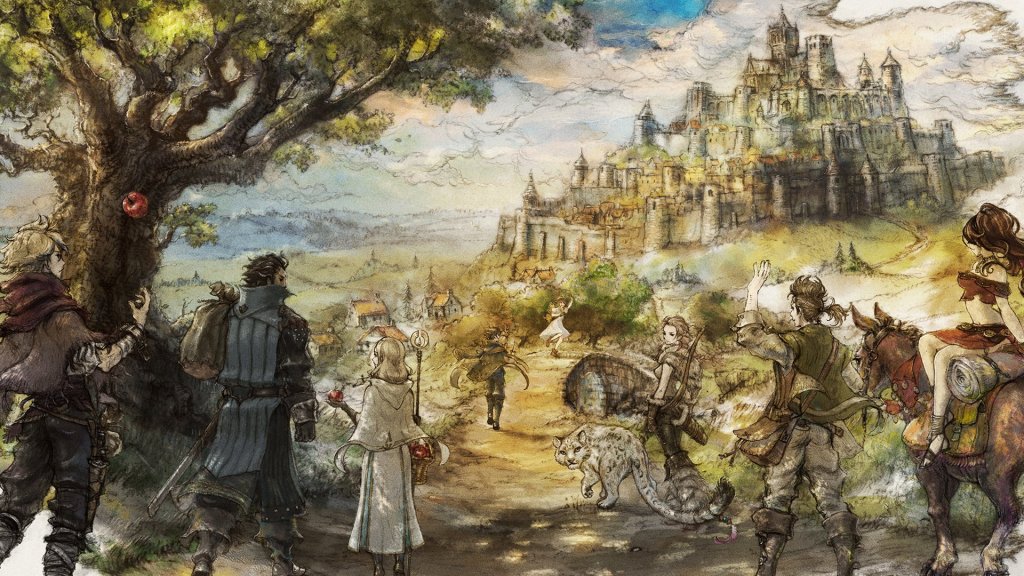
It should be a criminal act to show these characters together on screen.
I’ve probably uninstalled and reinstalled Octopath Traveler at least eight times in the two years I’ve had it on the Switch. It’s a game that literally bores me to tears every single time I play it, without fail. Slowly, my attempts have been growing more pathetic and ineffectual. My most recent attempt, which was the last thing I did before writing this, clocked in at around forty minutes (if you subtract the time I left the system on while lying in bed after the game nearly put me to sleep). I’m trapped in an endless cycle. A cycle where I play the game for a day or two in the attempt to get what everyone else is apparently getting: a good time. I then get so bored I uninstall the game, not out of spite or revenge or anything childish like that (it’s not like you can get revenge on an inanimate object or something. While we’re on the subject, if you’re the type of person that tries to physically harm inanimate objects, for example when you stub your toe on a Lego or something, you need to relax friend (I don’t know what kind of absolute unit of a Lego Structure you’d have to build to stub your toe on it, but you get the idea). Additionally, if you’re the type of person that gets mad at developers when you don’t like a game, I don’t know what to say to you). I did it because my Nintendo Switch simply didn’t have enough space. We all got sucked into the scam of having to buy a microSD card for the Switch’s mind-boggling 32 GB storage capacity at some point, but I was too lazy to buy one for the first year and a half or so I had it. So, like those people that do meal prep, I digitally set aside what games I would be playing the most on the Switch and uninstalled the ones I wouldn’t. Octopath Traveler would always end up on the chopping block. I can’t for the life of me figure out how to have fun in this game. If someone held me at gunpoint and forced me to play it to completion, I would simply die.
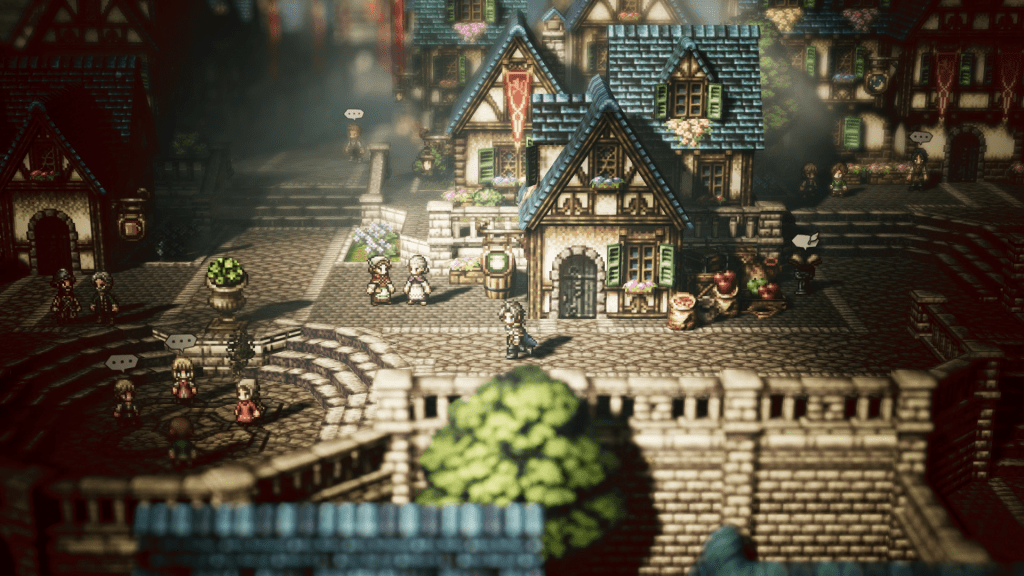
Where should I start. . . Octopath Traveler is a retro JRPG. It’s a throwback to everything people loved about the classics of the genre – while quietly removing the things that people hate, something that Yacht Club Games became really good at with Shovel Knight (except it’s a platformer). The game smears a fresh coat of paint on the collective memory of JRPGs with a seriously big-brain level of artwork. The main characters are all cute little 2D sprites with cute little animations. The monsters and enemies are also sprites, but they’re static. It sucks that they’re not animated but it’s made up for in the sprite-work itself: the pixel art is incredibly picturesque, something that wouldn’t really be possible if the artists had to animate every single one of the – what’s seems like – hundred monsters in the game. The environments are 3D and photorealistic, but they still have SNES visuals. It’s new, but it’s still old. It secretly rewrites the memories of those that played these games thirty years ago. From an artistic standpoint, this game is a wonderful achievement.
On other fronts, not so much. Don’t get me wrong, games that harken back to the good ol’ days are great. I love Shovel Knight (I wonder how many times I’m going to mention this game here). Granted, I wasn’t around during the era of games it calls back to. Despite that I still really like the game. And that’s because it can stand on its own. It can hit with the best of em’. It takes what people loved about the games it’s calling back to, and improves it in ways that the original couldn’t – in ways beyond art, like game design. I guarantee you, beyond a shadow of my doubt, that playing Shovel Knight provides a better play experience than its ancestors ever could. What makes the game so good is it romanticizes the before-times; it makes a genre that had a lot of issues seem almost perfect by seemingly rewriting history. For example, it doesn’t have a Game Over that punishes you for dying too much by restarting the whole game. Or it’s checkpoint system, where you can make the game easier for yourself by reaching them, or make it harder for yourself by destroying them, getting more money in the process. It’s a nice little risk reward mechanic. And it’s these small improvements in design that make retro games stand on their own. Octopath Traveler does this in some ways – like in the art – and not at all in others, and I don’t really know why.
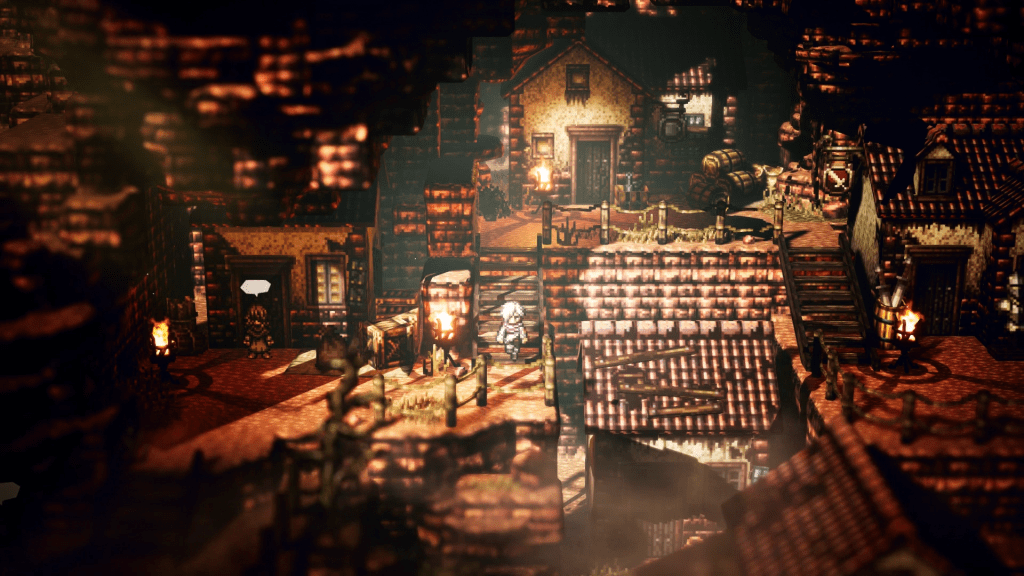
The most mundane of my issues is something that people have been complaining about since the Stone Age. Random encounters! In the past, random encounters were a way to organically put the player in front of enemies because it saves memory. Instead of having separate entities walking around on the map screen, it’s more efficient – both technologically and just in designing the game in general – to just have a random number generator decide when an enemy would hypothetically come to fight you. In the case of Octopath Traveler, they obviously didn’t have any stinky old hardware holding them back (I hope), but time was surely an issue. The team was only a group of like, ten people (or something). They clearly didn’t have the time to program actual enemies walking around in the world. It’s simply more efficient to just have RNG simulate how often someone that’s roaming around in the woods would encounter a pack of monsters. Still though, just because it had to be done doesn’t save it from criticism.
Random encounters in this game make me sick. You probably can’t go more than eight seconds without having to fight another brainless battle (we’ll get to the battles later). To be fair though, there is something to be said about how the game actually gets you paranoid about when the next encounter will happen. It’s tantamount to how I imagine it would be roaming a jungle in the middle of the night with animals hooting and hollering all around you: one of those things is bound to jump you eventually. Bottom line though, it’s jarring, it’s boring, and it’s compounded by the level design. The game will present you with a pretty good view of the surrounding environment, which is full of chests that are presumably full of sweet loot. The issue is, they’re almost always something useless. Like a healing potion. Something that you can mass hoard from town shops with chump change. It’s almost like they don’t trust players to actually buy stuff from shops. Or expect them to run out of potions somehow, when they’re so insanely cheap. The feeling that you get after trekking for what seems like forty miles across an invisible monster field only to get a fucking healing potion for your troubles feels like getting your soul sucked out through every pore in your body. And it happens all the time. Granted, there are special chests that are differently colored which have better stuff in them. But the bonus stats that you get from a weapon or whatever else is in there is never worth it. I ended up just ignoring chests on my later retries of the game. It’s simply not worth the pain. What’s worse, the space between the chests and you are just empty corridors. There’s absolutely nothing interesting going on. There’s a single path that takes you to your destination, and then there are branching paths that take you to treasure chests. If we’re being real though, most JRPGs are like this, but at least they make an effort to hide it. In Octopath Traveler, the paths literally look like paths – ironic. Like, somehow the Earth in this game just happened to naturally form perfectly structured sidewalks for everywhere you want to go. It’s absolutely mind-numbing. You fall into this endless loop anytime you’re not in a town of walking down a corridor, doing a battle, then walking down a corridor again. You either find a dead end, a treasure chest, or the boss room. Over and over again. It doesn’t feel like a world. There’s no exploration. There’s no adventure. It’s not even Traveling. It’s just walking.
It’s not just that the level design is streamlined and uninspired, and that random encounters kill the momentum of the game. The actual battles themselves are painful too. On paper, it’s amazing. Enemies have armor that reduces the damage they take. Target their weaknesses – fire or swords for example – enough times to destroy their armor and knock them unconscious for a turn. You can also use battle points (BP) that you build up every turn to boost your attacks. Boosting weapon attacks multiplies the number of times it hits an enemy. Boosting spells multiplies their damage. Upon learning this information in the game, strategy emerges. Since every individual attack will always reduce enemy armor by one, you can use boosts on your swordsman’s turn to increase the number of times a weapon hits your enemy. Then, when their armor is broken, you can maximize damage by boosting a spell on your mage’s turn. While doing this, you’re keeping in mind turns taken to heal party members, use items, or defend. This system should create a healthy sea of complexity to immerse yourself in. In some cases, it does. In a lot of others, it doesn’t. For example, after defeating the same formation of enemies for the fifth time, whatever deep strategy you might have for killing them crosses the line from engaging to tedious. Think of each combat scenario as a puzzle. Each enemy type has their own armor value, some might have a value of two, others, a value of four. They also have their own set of weaknesses, some might have elemental weaknesses of fire, lightning, and dark, and weapon weaknesses of swords, and spears. Others have, well, other weaknesses. Eventually you find a seemingly perfect way to kill the enemies. A way that’s as efficient that you can make it; a way that uses boosts on one character to whittle away armor on as many monsters as possible, and uses boosts on another character to do as much damage to as possible to as many monsters as possible once their weakened (and going further, use boosts to buff damage dealers, so on so forth). In effect: you’ve solved the puzzle. The issue is, no matter your methods, without a doubt, it will always take multiple turns to whittle away your enemies. Especially later when they start to get higher armor valued monsters. After you’ve fought against the same enemy groups a bunch of times, it starts to get really annoying. Because you’ve already solved the puzzle! Yet, you’re forced to continue the cruel farcical exercise for as many times as these sadistic designers please. It’s like – well, this is a hilariously braindead analogy but, it’s like solving a jigsaw puzzle. Imagine you, as your little tiny two-year-old self, were given a nice nine-piece jigsaw puzzle with a nice little picture of the country side and a cow, from your parents. Then you put it together! It’s a happy fun time, little baby dopamine molecules release into your brain (or wherever, I’m not a doctor). Imagine then that your parent jumbles it up and tells you to put it back together again. Like, what? I don’t know, maybe I’m giving toddlers too much credit but I’m sure your tiny little two-year-old self would have enough sense to realize how dumb this would be. What the heck is the point of putting a puzzle together that I already fucking solved? The fun part is solving it! Now, imagine your mommy or daddy held you at gun point and forced you to solve the puzzle 800,000 times and that essentially paints the picture of what Octopath Traveler feels like to play.
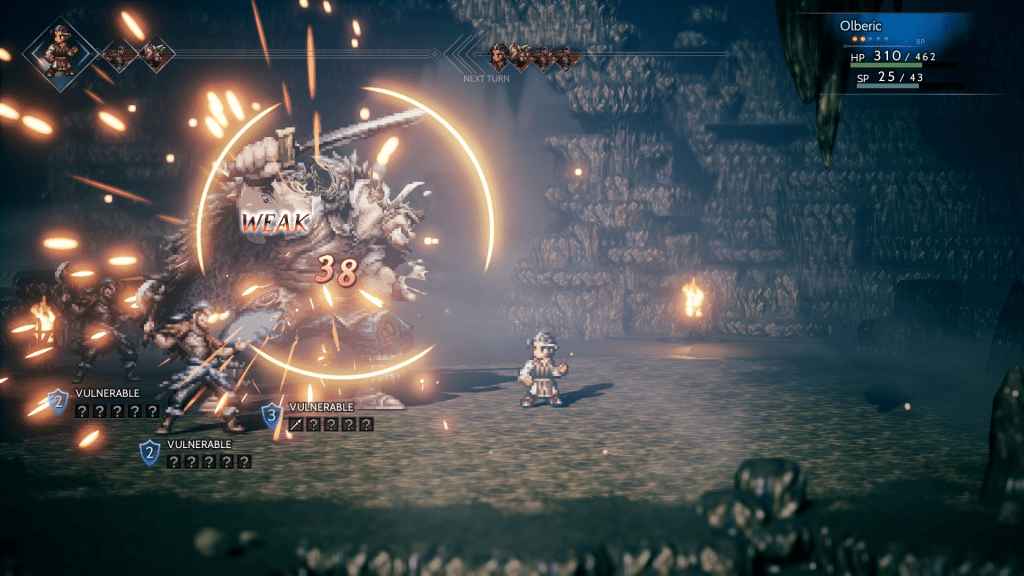
Now, it’s true that a lot of JRPGs are about doing the same thing over and over again; like any good game though, it should be fun to do the same thing over and over again. Breaking a monster’s armor doesn’t feel good. There’s not enough crunch and stopping power. There’s no freeze frame. Unleashing a powerful spell doesn’t feel good either. There’s not enough build up or flourish to them. A lot of that comes down to the retro aesthetic the team went for: monster sprites are static (though they’re still extremely pretty) and character sprites are too tiny and cute and chibi for any interesting animations. Weapon and spell affects are either bland or borderline non-existent. It makes the high-points of battle feel low. It makes doing the same thing over and over again feel like a chore. Conversely, a JRPG like Persona 5 Royal congratulates you for solving its puzzles. Learn an enemy weakness in that game. Then, when you come across a group of monsters whose weaknesses are known, you can win the battle in a matter of seconds – thanks to interesting mechanics like One More, Baton Pass, and All Out Attack where if you hit a monster’s weakness you instantly get an extra turn and can pass it on to another party member who has a spell that can target the weakness of a different monster, once you weaken all monsters in battle you can blow them away in a team attack; they’re fun, snappy mechanics with punchy animations that lead to insanely interesting decisions. Persona 5 (as well as the other games in the series) is a game that respects your time. Battles where you ‘know the answer’ are quick, painless, and fun. And you can choose them. There are no random encounters. It’s great! Though I guess there’s something to be said about ‘combat in JRPGs’ when a game that does ‘combat in JRPGs’ best, does it as little as possible.
Another point of contention that people on the internet have: the story. Or, I guess, eight different stories. Now, it’s hard to criticize a story that I haven’t even completed yet (and trust me, I’m still trying), I’m going to do it anyway. Because I’m honest, and I’m nice. This is what people like to say: the story is generic. Let me be clear. That that’s not fair at all. It seems to me, that the writing is calling back to the before-times of JRPGs. Of Dragon Quest and – in some cases – Final Fantasy. Simple bed-time fairy tales with an interesting premise. Stories that you can put down for months on end and pick right back up where you left off. Strong, yet elegant character writing; games that let the game tell the story as much as the dialogue. Your dad has gone missing and you need to find him. Your entire village has been turned to frogs. You’re the chosen one, bestowed with the power to destroy a great evil, but there’s none to be found. Okay, I’m just describing Dragon Quest. In some respects, Octopath Traveler is reminiscent of stories like these. You have to find a mysterious, ancient book stolen from the library fifteen years ago. Or, you’re looking for the men who murdered your father. They’re simple premises with intrigue, mystery, and substance. The issue is, there’s eight different characters and eight different stories. How does the game reconcile with this? By having each character’s tale play out separate from the rest of the group. And I mean completely separate. As far as I know (and as far as I got to) your party members literally don’t interact with each other at all. It’s eerie. Like, they might be walking together in a cute little line in the overworld, but they never talk to each other. They never acknowledge each other. Not even a simple, “hello”, when you recruit someone. During one character’s – for example, my main character is Cyrus – storyline cutscene, the other’s never show up. It’s as if the entire time the other party members never existed; Cyrus simply imagined he had friends, and he was walking around the wilderness by himself all along. All those battles he fought alongside his buddies were actually fought alone. It sounds like a cringe revelation at the end of a B-movie, but honestly, it would make way more sense than whatever weird mental gymnastics you’d have to do to suspend your disbelief. You’d think that with eight different stories the game would be jam-packed with content, and it kinda is. But it still ends up feeling so sparse and dead. Playing Chapter One of a character’s story and wanting to know what happens in Chapter Two means having to go through the seven other chapters of the others. It’s genuinely depressing. Like, not only do these characters – that are actually fairly interesting individually – not interact with each other, but whatever tiny semblance of joy you might derive from one particular character’s storyline is violently ripped from your arms as the game thrusts you into Origin Story #5. Just because it’s more ‘content’ doesn’t mean it’s good. And now that I think about it, I’m pretty sure this is why people think the story is ‘generic’ too. These simple premises never get the time to breathe when we’re hopping from one origin story to the next. By the time the next chapter rolls around, all intrigue is lost. A wine-glass swirling video game connoisseur would call this bad pacing, but it’s beyond that. It’s just weird. Why not just have the main character as best boy Cyrus and have the story be all about him? Well, probably because that would be too much work.
Thanks for reading.
Here’s an interesting Unreal Fest presentation from Octopath Traveler’s Director and Lead Artist: https://www.youtube.com/watch?v=K6wW0pO08LE

 Slickaria!